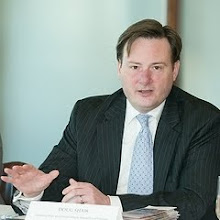
AAAS’s blog ScienceInsider reported yesterday that Dr. John Holdren is about to be named as President Obama’s Science Advisor.
Prof. Holdren is a leading expert on nuclear non-proliferation and arms control.
In 1997, he chaired the National Academy of Sciences report “The Future of Nuclear Weapons Policy” which made recommendations that are as relevant today as they were then. This NAS report recommended:
· the adoption of a policy of minimum deterrence
· adoption of a no-first use policy
· taking nuclear weapons off hair-trigger alert
· reducing U.S. and Russian nuclear forces to 1,000 total warheads
· and explored the issues related to reducing to a few hundred warheads.
Dr. Holdren summarized the findings and recommendations of the report in a 2005 Arms Control Today op-ed in which he noted the need to implement these important recommendations:
“The committee's advice has largely been ignored, however, first by the Clinton administration, which had no appetite for the internal battles that embracing the recommendations would have entailed, and then by the Bush administration, which appears untroubled by the logical disconnect between its expansive view of the role of U.S. nuclear forces and its expectation of nuclear restraint from everyone else … Notwithstanding the unfortunate fate of the 1997 recommendations to date, they continue to constitute a sensible blueprint for reducing the role of and dangers from nuclear weapons in the early 21st century”
and
“The status quo is not stable. If nuclear weapons roles and dangers are not deliberately and relentlessly made smaller, they will get bigger. The largest nuclear-weapon states must lead the way, not drag their feet. The United States and Russia have managed to dismantle thousands of nuclear warheads and delivery systems made obsolete by the end of the Cold War. Now it is time to get on with dismantling our equally obsolete nuclear weapons policies.”
Three cheers for Dr. Holdren’s appointment!
Friday, December 19, 2008


Tuesday, December 9, 2008
So-called "Nuclear Powers" Aren’t
The Korea Times reports today that the recently released annual report by U.S. Joint Forces Command, “Joint Operating Environment 2008: Challenges and Implications for the Future Joint Force,” lists North Korea as a “nuclear power.” Perversely, the Nuclear Non-Proliferation Treaty, which shapes the environment for joint operations significantly by limiting the number of nuclear arsenals globally, is not mentioned in the document.
The section entitled “The Contextual World” begins its discussion of “The Pacific and Indian Oceans” as follows:
Nuclear weapons may confer political status, but this is as much a dysfunction of contemporary global politics as it is a reflection of some real utility of nuclear weapons in meeting the needs of states. Nuclear weapons are exceedingly dangerous to U.S. and global security and North Korea’s acquisition of nuclear weapons is clearly destabilizing to the region. But nuclear weapons do not transform North Korea’s role in the world; they are a symptom and contributing cause of North Korea’s national tragedy.
Kim Jong Il styles himself an alchemist, hoping nuclear weapons will transform his comparative advantage in ignoring global norms and violating international law into security and foreign investment. It is unclear that he has achieved security or even broken even economically. He has impoverished his people and alienated them from the world community. A small nuclear arsenal may provide him a fig leaf of deterrence sufficient for human rights atrocities and petty criminality, but it has not transformed him into a globally relevant leader.
The U.S. Government should make this clear by consistently and assertively rejecting Kim’s mystical belief that nuclear weapons make him powerful; this includes consistently rejecting the use of the term “nuclear power” to describe any state.
The section entitled “The Contextual World” begins its discussion of “The Pacific and Indian Oceans” as follows:
“The rim of the great Asian continent is already home to five nuclear powers: China, India, Pakistan, North Korea and Russia. Furthermore, there are three threshold nuclear states, South Korea, Taiwan, and Japan, which have the capacity to become nuclear powers quickly.”Such colorful writing may enliven the read, but it dangerously distorts the picture of Asian and global security presented in the report. While North Korea, appears to have tested a nuclear explosive device and maintains a conventional military of unusual size, it has by no means earned the status of “power” somehow analogous to Russia, China, and India.
Nuclear weapons may confer political status, but this is as much a dysfunction of contemporary global politics as it is a reflection of some real utility of nuclear weapons in meeting the needs of states. Nuclear weapons are exceedingly dangerous to U.S. and global security and North Korea’s acquisition of nuclear weapons is clearly destabilizing to the region. But nuclear weapons do not transform North Korea’s role in the world; they are a symptom and contributing cause of North Korea’s national tragedy.
Kim Jong Il styles himself an alchemist, hoping nuclear weapons will transform his comparative advantage in ignoring global norms and violating international law into security and foreign investment. It is unclear that he has achieved security or even broken even economically. He has impoverished his people and alienated them from the world community. A small nuclear arsenal may provide him a fig leaf of deterrence sufficient for human rights atrocities and petty criminality, but it has not transformed him into a globally relevant leader.
The U.S. Government should make this clear by consistently and assertively rejecting Kim’s mystical belief that nuclear weapons make him powerful; this includes consistently rejecting the use of the term “nuclear power” to describe any state.
Monday, December 8, 2008
France out front in a brace of moves toward nuclear disarmament
The Associated Press reports that a letter from French President Nicholas Sarkozy to United Nations Secretary General Ban Ki Mun outlines a European Union plan to advance global progress toward nuclear disarmament:
With regard to a fissile material production cutoff, The Times of India reports:
The letter carries added multilateral weight as France currently holds the rotating presidency of the European Union, a post it will relinquish this month.
President Sarkozy’s letter foreshadows tomorrow’s official launch in Paris of the “Global Zero” citizens campaign for a world without nuclear weapons. Featured leaders of this effort include former United Kingdom Foreign Secretary Margaret Becket who proposed last year that her country become a “disarmament laboratory” to develop the verification procedures and technology necessary to move toward the abolition of nuclear weapons. Entrepreneur and adventurer extraordinaire Sir Richard Branson is another campaign leader – having built the Virgin brand into a global phenomenon, he is perhaps uniquely qualified to again popularize the “unnatural act” of arms control.
"Europe has already done a lot for disarmament…[and]…Europe is ready to do more."French newspaper Le Figaro reports that the December 5 letter supports further (post-START) nuclear arms control negotiations between the United States and Russia, universal ratification of the Comprehensive Test Ban Treaty and dismantlement of all nuclear installations as soon as possible in a transparent and open way (the article notes that this issue refers particularly to Russia and China which maintain operational testing sites), a moratorium on fissile material production, and short- and medium-range surface-to-surface ballistic missiles.
With regard to a fissile material production cutoff, The Times of India reports:
"The opening without delay and without preconditions of negotiations on a treaty forbidding the production of fissile material for nuclear weapons, as well as the implementation of an immediate moratorium on the production of these materials."Le Figaro notes the intent of the letter is to “raise the debate to the level of heads of state.”
The letter carries added multilateral weight as France currently holds the rotating presidency of the European Union, a post it will relinquish this month.
President Sarkozy’s letter foreshadows tomorrow’s official launch in Paris of the “Global Zero” citizens campaign for a world without nuclear weapons. Featured leaders of this effort include former United Kingdom Foreign Secretary Margaret Becket who proposed last year that her country become a “disarmament laboratory” to develop the verification procedures and technology necessary to move toward the abolition of nuclear weapons. Entrepreneur and adventurer extraordinaire Sir Richard Branson is another campaign leader – having built the Virgin brand into a global phenomenon, he is perhaps uniquely qualified to again popularize the “unnatural act” of arms control.
Wednesday, June 4, 2008
More on McCain's speech
In his speech about nuclear weapons issues delivered on May 27, 2008, Senator John McCain raised important issues for the next Administration. His remarks signaled a welcome shift from the Bush Administration's repudiation of important tools that can effectively reduce the dangers posed by nuclear, biological, and chemical weapons, tools which served us well during the Cold War and which remain important for the continued viability of the non-proliferation framework.
Senator McCain's remarks signal a significant change from the Bush Administration in certain important areas, including a renewed commitment to pursuing further legally-binding and verifiable reductions in the number of U.S. and Russia nuclear weapons; opening a discussion on the ratification of the Comprehensive Test Ban Treaty (CTBT); strengthening efforts to secure vulnerable bomb-grade material; pursuing negotiations for a Fissile Material Cut-Off Treaty (FMCT); and increasing funding for the International Atomic Energy Agency (IAEA).
Questions remain about specific policies, including whether Senator McCain will continue the successful engagement with North Korea to achieve a verifiable dismantlement of its nuclear weapons program, and whether he will be willing to negotiate directly with Iran. Another concern is his support of an ineffective and provocative missile defense which rankles the Russians and does nothing to reduce the more likely risk of a hostile country or terrorist group detonating a nuclear weapon in the United States or from a U.S. harbor.
For a more detailed analysis that I prepared for the Center for Arms Control and Non-Proliferation, click here.
Wednesday, May 28, 2008
Senator McCain’s Vision for a World of Fewer Nuclear Weapons
In a speech at the University of Denver, presumptive Republican presidential nominee and Senator John McCain argued yesterday for a new legally binding and mutually verified arms reduction agreement with Russia:
“While we have serious differences, with the end of the Cold War, Russia and theNukes on a Blog’s own Leonor Tomero commented on Senator McCain’s speech on the Brian Lehrer Show this morning.
United States are no longer mortal enemies. As our two countries possess
the overwhelming majority of the world's nuclear weapons, we have a special
responsibility to reduce their number. I believe we should reduce our
nuclear forces to the lowest level we judge necessary, and we should be prepared
to enter into a new arms control agreement with Russia reflecting the nuclear
reductions I will seek. Further, we should be able to agree with Russia on
binding verification measures based on those currently in effect under the START
Agreement, to enhance confidence and transparency. In close consultation
with our allies, I would also like to explore ways we and Russia can reduce –
and hopefully eliminate – deployments of tactical nuclear weapons in
Europe.”
Tuesday, April 15, 2008
A little more lost plutonium gets accounted for

After the “unacceptable mistake” of having unintentionally flown six-nuclear tipped weapons across the country, and the mix-up that resulted in nuclear missile fuses, rather than helicopter batteries, being sent to in Taiwan, bad news about nuclear weapon mistakes may come in threes:
Most recently, a story from the Spanish newspaper El País (a summary of which appeared on the website http://www.typicallyspanish.com/) reported last week that Teresa Mendizábal, the Director of the Environment Department of the Energy, Environment, and Technology Research Centre, CIEMAT (part of the Ministry of Education), stated that 1,000 square meters of radioactively contaminated material, containing plutonium and americium, have been found near Palomares, Spain.
The contaminated material has been discovered 42 years after the Palomares accident where four U.S. hydrogen bombs fell over the village of Palomares (in the Almeria region in Southeastern Spain) following a 1966 mid-air collision between a U.S. B-52G bomber and tanker aircraft during in-flight refueling (which killed all crew members). Three nuclear weapons were recovered in Palomares and a fourth was recovered from the Mediterranean Sea. While the nuclear weapons did not detonate, two of them contaminated part of the area (releasing more than 20 kg of plutonium according to a PressTV article). In 1966, the US military airlifted contaminated soil from the site of the crash. Cietmat has been conducting monitoring studies of the area for over 40 years, because of concerns about the above-ground and wind-blown soil, and started decontamination in 2004. Now underground contamination from buried soil has been found as well. The article reports that the US military stated at the time of the accident that it air-lifted all the plutonium-contaminated soil (1.6 million tons), but hid the fact that it had buried some remaining soil in two ditches in 1966.
The article notes that until 2004, lettuce was being grown above the buried waste, and there were plans to develop the area. The article indicates that a formal agreement on clean up of the contamination at Palomares (the extent of which was yet unknown) was reached with the United States in 2006, when the United States provided $2 million for the soil studies. The article notes that it is expected that the United States will remove the contaminated underground soil (further negotiations are expected in June with the US Department of Energy when a US delegation will travel to Spain), as Spain has argued that it cannot store plutonium.
The legacy of this incident underscores the unintended dangers necessarily associated with nuclear weapons operations.
Monday, March 10, 2008
Doctors gather in global opposition to nuclear weapons
This week in New Delhi, India about 400 doctors and 300 medical students from over fifty countries met to discuss and plan action responsive to their shared commitment to the abolition of nuclear weapons. The 18th World Congress of International Physicians for the Prevention of Nuclear War (IPPNW) was inaugurated with a speech by the Vice President of India, Shri M. Hamid Ansari, who recalled India's tradition of advocacy for nuclear disarmament, including its role in proposing a nuclear test ban in 1954 and a non-proliferation treaty in 1965 (unfortunately, India would refuse to sign the Non-Proliferation Treaty concluded three years later). The Vice President surfaced a three-point plan for Indian leadership on nuclear disarmament, calling for universal reaffirmation of the goal of the elimination of nuclear weapons, negotiation of a convention prohibiting the use or threat of use of nuclear weapons, and a Nuclear Weapons Convention that would ban production, stockpiling, or use of nuclear weapons in a global, nondescriminatory, and verifiable plan for the elimination of these weapons in a specified time frame.
The World Congress featured detailed discussions on a variety of related topics, including the signature effort of IPPNW, the International Campaign to Abolish Nuclear Weapons (ICAN) initiated last year under the leadership of Dr. Tilman Ruff of Australia. Other topics inlcuded opposition to the U.S.-India agreement on peaceful nuclear cooperation, the danger of global "nuclear famine" resulting from even a limited regional nuclear war, globalization and militarization, torture, and religious intolerance.
ICAN physician diplomats held meetings with the President and the Prime Minister of India on the margins of the World Congress to encourage India to assert a more active leadership role in moving toward a world free of nuclear weapons. This work builds on the model of physician diplomacy for which IPPNW was awarded the 1985 Nobel Peace Prize and holds substantial promise for widening and deepening the commitment of governments worldwide to work toward the abolition of nuclear weapons on the basis of facts and expert medical testimony physicians are able to provide on the dangers nuclear weapons pose to human life and health.
Subscribe to:
Posts (Atom)