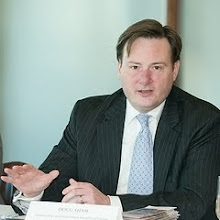
Thursday, April 15, 2010
Higher Education and the Nuclear Summit
Menachem Wecker recently interviewed me about the Nuclear Security Summit and how it relates to higher education; the interview is available at The George Washington University homepage at http://www.gwu.edu/explore/gwtoday/learningresearch/defusingthenuclearthreat


Wednesday, March 17, 2010
Faculty Goals and Resource Needs for Nuclear Nonproliferation and Safeguards Education
Remarks Delivered by
Douglas B. Shaw
at the U.S. Department of Energy’s
Next Generation Safeguards Initiative Human Capital Development Conference
hosted by Los Alamos National Laboratory in cooperation with
Douglas B. Shaw
at the U.S. Department of Energy’s
Next Generation Safeguards Initiative Human Capital Development Conference
hosted by Los Alamos National Laboratory in cooperation with
Texas Agricultural and Mechanical University
Santa Fe, New Mexico
August 10, 2009
August 10, 2009
This spring, the celebrated deterrence theorist and historian of nuclear strategy Sir Lawrence Freedman visited the Elliott School and observed an imperative for higher education to respond to a “lost generation” of nuclear weapons specialists. Others have made similar observations.
In explaining his decision to host a July 2009 conference on “Waging Deterrence in the 21st Century,” General Kevin Chilton, commander of the U.S. Strategic Command, observed “I think we have allowed an entire generation to skip class, as it were, on the subject of strategic deterrence.”
In introducing the 2002 United Nations Study on Disarmament and Non-Proliferation Education, then Secretary-General Kofi Annan found it “striking for someone of my generation to think that an entire new generation of human beings is coming to maturity without an ever present terror of nuclear catastrophe. Yet it is so, and that is for the better. The downside, however, is ignorance of the real dangers that do exist, especially the legacy of nuclear weapons inherited from the last century. Moreover, the companion of ignorance is complacency: what we know little about, we care little to do anything about.”
Our host, Dr. James Doyle, wrote in his paper “Nuclear Security as a Multidisciplinary Field of Study,” that “[o]ver the next five years, some 50 percent of the IAEA’s top inspectors are expected to retire, taking with them key institutional knowledge and technical skills.” The challenge before us is as immediate and global as it is important.
I am grateful to Jim and Los Alamos National Laboratories for hosting this meeting, the National Nuclear Security Administration’s Next Generation Safeguards Initiative for making it possible, and to all of you for constituting such an exciting program. I am humbled to be included, but assure you that my students this fall will benefit substantially from this discussion.
Jim has asked me to address faculty goals and resource needs for nonproliferation and safeguards education. I will approach this task by reflecting on the four basic goals Jim identified in his paper. First, the interdisciplinary character of nonproliferation; second, the need to confront real-world problems; third, empowering students to balance the costs and benefits of nuclear technology; and finally, the incorporation of experiential learning. These are just a few ideas and my only pride in suggesting them is that the audience assembled to receive them is so capable of improving upon them.
Jim has asked me to address faculty goals and resource needs for nonproliferation and safeguards education. I will approach this task by reflecting on the four basic goals Jim identified in his paper. First, the interdisciplinary character of nonproliferation; second, the need to confront real-world problems; third, empowering students to balance the costs and benefits of nuclear technology; and finally, the incorporation of experiential learning. These are just a few ideas and my only pride in suggesting them is that the audience assembled to receive them is so capable of improving upon them.
I. Interdisciplinary Foundations
The first basic goal of nonproliferation education that Jim identifies is that graduate and undergraduate programs in nuclear security should “provide the necessary fundamentals in nuclear security science from across the physical and social sciences.” This observation echoes the observation of the United Nations study I mentioned earlier that “new formal and informal curricula should…adopt a multidisciplinary approach.”[1]
This is a huge task. Jim identifies more than a dozen disciplines as immediately relevant to nuclear security. Most colleges and universities are organized by disciplinary departments effectively stove-piping faculty credentialed hired, socialized, promoted, tenured, and evaluated in these disciplinary departments away from interdisciplinary collaboration. While there are countervailing initiatives and even trends, interdisciplinary work can be hazardous to the career prospects of many young faculty members.
Some institutions will find the organization of interdisciplinary programs easier than others, but from a vantage point inside the Elliott School of International Affairs, an explicitly interdisciplinary institution organically focused on responding to global human problems with policy engagement built into its mission on an equal footing with research and teaching, I can say with confidence that this will always imply tensions.
Managing these tensions and creating a strong foundation for nonproliferation education in several disciplines will require incentives to draw more faculty into this area of teaching. There are many ways to do this, three stand out to me as particularly achievable. Funding research on nonproliferation-related topics that engages the current methodological and scholarly debates in each relevant discipline could attract faculty to greater practical nonproliferation expertise while advantaging those who engage in scholarship on these topics in their pursuit of tenure and recognition within their disciplines. Similarly, creating faculty sabbatical opportunities with careful attention to their professional growth requirements could make it easier for more scholars to focus more energy on these topics. Finally, higher education environments vary considerably. Creating institution-specific partnerships would have the benefit of engaging the leadership of these colleges and universities to encourage their faculty with the spectrum of specific tools at their disposal.
II. Real-world Problems
Jim’s second basic goal is to “provide an understanding of the unique challenges that arise when applying these fundamentals to real-world problems.”
We may benefit here from a parallel effort undertaken by the Director of Columbia University’s Earth Institute, Professor Jeffrey Sachs in teaching sustainable development. In a recent op-ed co-authored by Sachs and Millennium Promise CEO John McArthur in the Chronicle of Higher Education, the authors describe the problems of sustainable development as:
“complex and interconnected, spilling across academic disciplines and often across national borders. Solutions will require theoretical knowledge and practical problem-solving skills, including the capacity to build and lead teams drawn from a variety of disciplines. This will require leaders who can cross boundaries of science, policy, geography, theory, and practice.”[2]
Sound familiar?
Their response at the Earth Institute, modeled on the Flexner Report of 1910 that “revolutionized and standardized systematic training for medical doctors in North America” undertook to assess current sustainable development education and make recommendations for a transformation of professional education – specifically, a new form of degree program they call the “master’s in development practice” to provide a grounding in several disciplines but also substantial “clinical” training to educate students to build interdisciplinary teams indifferent to their geographic location or dispersion responding to undertake case studies and field work. This effort, underwritten by a $15 million grant from the John D. and Catherine T. MacArthur Foundation aims at nothing less than the global transformation of an emerging profession.
Needless to say, $15 million is important among my suggestions for resources needed to stimulate new teaching for nonproliferation, but I suspect this effort has more to teach us about the integrative work of connecting our disciplinary perspectives into the formation of future nuclear security professionals. The Next Generation Safeguards Initiative could convene a discussion to define the future professions necessary for nuclear security and seed the establishment of model professional degree programs to support them, support a network of schools offering these types of programs, and regularly convene meetings like this one to establish a network of faculty teaching on nonproliferation and alumni who have received this training, perhaps forming the core of new professional organizations. These efforts should leverage other networks already under development, such as the United Nations annual reporting on Nonproliferation and Disarmament Education, the efforts of the International Association of University Presidents, and the work of pioneers in this field, particularly including the James Martin Center for Nonproliferation Studies.
Needless to say, $15 million is important among my suggestions for resources needed to stimulate new teaching for nonproliferation, but I suspect this effort has more to teach us about the integrative work of connecting our disciplinary perspectives into the formation of future nuclear security professionals. The Next Generation Safeguards Initiative could convene a discussion to define the future professions necessary for nuclear security and seed the establishment of model professional degree programs to support them, support a network of schools offering these types of programs, and regularly convene meetings like this one to establish a network of faculty teaching on nonproliferation and alumni who have received this training, perhaps forming the core of new professional organizations. These efforts should leverage other networks already under development, such as the United Nations annual reporting on Nonproliferation and Disarmament Education, the efforts of the International Association of University Presidents, and the work of pioneers in this field, particularly including the James Martin Center for Nonproliferation Studies.
III. Understanding the Need to Balance Risks and Benefits
Jim’s third basic goal is developing “understanding of the need to balance the risks posed by nuclear technologies with their benefits.”
Nuclear technology has complex societal effects. The human tendency toward war made nuclear weapons inevitable, but nuclear weapons are thought to control this tendency, assuming human beings can control these weapons in the context of our fallibility. We identify nuclear terrorism and proliferation as the greatest threats to our security but make only modest investments in response.
The question of peaceful uses of nuclear technology is interwoven with the question of nuclear proliferation and terrorism and adds its own additional complexity. At its beginning, nuclear energy promised power too cheap to meter. Decades later, we still don’t know what it costs. National governments necessarily have a role to play in anything that contains so much promise and danger, but what that role should be is intensely contested.
What I take from this goal is that there are immediate and significant moral implications for our work as educators. Our students will live with challenges we can’t imagine today. For example, Rose Gottemoeller, who now serves as the Assistant Secretary of State for Verification, Compliance and Implementation tasked by President Obama to negotiate a new nuclear arms reduction agreement with Russia; Adam Scheinman, who played a leadership role in the established of the Next Generation Safeguards Initiative and now serves as the director for nonproliferation at the National Security Council; and Thomas Troyano, who leads the Office of Treaty Compliance in the Pentagon all studied security policy at the Elliott School in the 1980s. No case studies or fieldwork designed at that time could be perfectly relevant to today’s challenges. We need to open our students’ imaginations beyond today’s challenges. This is hard, but as scholars committed to revealing truth, our work is not value neutral. As Georgetown University President Jack DeGioia observes, “the truth makes demands of us.”
He approaches this problem through the creation of flagship courses, one on human rights and another on ethics and global development designed to get students talking about these value-laden topics outside the classroom by making them more visible and widening student interest.
High-profile speakers – like the Secretary of Energy or the White House Science Advisor – touring campuses would raise student awareness considerably. Awards and essay competitions – like the one that got Hans Blix interested in the field – have impacts that extend through time and beyond their winners. These kind of efforts hold promise for shifting the curve of awareness up across entire student bodies and widening the conversation to include ethical and political considerations in the uncontrolled real world with information and theoretical frameworks reliably supplied in the classroom.
IV. Experiential Learning
Jim’s last basic goal, to “include the opportunity for hands-on training (internships, lab experiments, [and] simulation exercises)” also aligns with the UN Study’s call for participatory learning, in particular role-playing and simulations.[3]
One valuable step would be technology and travel support to help connect classes at different institutions in simulations – simulations require a lot of energy from both students and faculty, the structure and added momentum of participants from other departments or institutions can reinforce these efforts.
Exhibits, models, and mock-ups – when students touch unusual objects that relate to unfamiliar subjects, they can better visualize the settings and processes relevant to these subjects and they feel more connected and attracted to the topic area. Traveling exhibits and permanent collections in cities with several universities could make a lasting impression on students.
Guest speakers with real world experience – nonproliferation and safeguards are extraordinarily complex topics and many key documents are dry and difficult to teach – the Additional Protocol is one example of critical document that is difficult to teach because it is obtuse and boring to read. Sharing lived experiences can contribute to deeper student engagement.
Multimedia – different people learn differently; unfortunately individual faculty have limited capacity to develop diverse teaching resources themselves. I recall when I was at the Department of Energy I had the opportunity to use a CD-ROM training program called Nuclear Material Control and Accounting 101. This particular resource might not be appropriate for general distribution, but something similar could be produced and even made available online and would provide a multi-media learning opportunity for my students that I could not produce on my own.
These have been just a few examples: encouraging multidisciplinary teaching by creating career incentives for faculty, seeding transformational programs and seeking a vision of emerging professions and creating a global network to engage real-world problems, widening campus conversations about the risks and benefits of nuclear technology, and making tailored multimedia resources, guest speakers with vivid real-world experience, and networking technology to drive more exciting simulations available to faculty teaching on nonproliferation and safeguards. I look forward to learning from you what other resources would be useful and how we might work together to assemble them. Thank you.
Everybody's Bomb: Urgency, Inclusion, and Hope in Response to Nuclear Weapons
Remarks as Prepared for Delivery byDouglas B. Shaw on March 16, 2010
At a Woodstock Theological Center Forum on "God and the Bomb: Deterrence, Disarmament and Human Security" at Georgetown University
In December, the fellows and leadership of the Woodstock Theological Center engaged in a discussion on the topic of “Nuclear Deterrence or Disarmament: A Global Human Choice.” With their help, I better understand that the weighty historical choices humanity faces today are not between deterrence and disarmament but between engagement and what Woodstock Senior Fellow Delores Leckey termed “a kind of great apathy that we are part of and complicit in.” In response to my greater awareness of my own complicity in this great apathy, I am grateful to Father Lo Biondo for organizing this forum and Archbishop Migliore, Father Langan, Professor Maryann Cusimano Love, and all of you for the opportunity tonight to offer my thoughts on urgency, inclusion, and hope in response to nuclear weapons. My hope is that everyone here tonight will leave carrying a little more responsibility for what I think of as everybody’s bomb.
I. Nuclear weapons require an urgent response
A little more than twenty years ago, the fall of the “iron curtain” revealed a “nuclear archipelago” of vulnerable fissile material – plutonium and highly enriched uranium that could be used by terrorists to make nuclear weapons – across the former Soviet Union. At the same time, glacially slow arms control negotiations between the United States and Russia finally began to result in actual agreements requiring on-site verification and implementation. The prospect of nuclear terrorism displaced the Cold War order; as President Barack Obama has observed, “[i]n a strange turn of history, the threat of global nuclear war has gone down, but the risk of a nuclear attack has gone up.”
In light of these developments, some of which are now two decades past, many people think that nuclear weapons are yesterday’s news; that the danger nuclear weapons pose went away with the end of the Cold War. The truth is that as long as nuclear weapons exist, they pose an extraordinary threat to human life and civilization and this danger requires urgent action.
Immediate danger
This danger is immediate and stems from a combination of factors: terrorists intent on using nuclear weapons, the potential availability of these weapons or materials that could be used to make nuclear weapons, and lapses of security. In the asymmetric struggle against terrorism, nuclear weapons are worse than useless – they are a liability: a potential source of incredible destructive power for terrorists, an obstacle to reductions in nuclear weapons and weapons-usable nuclear materials elsewhere, and used by some as evidence of the injustice and indiscriminate violence embedded in the contemporary world order.
Founding Dean of the John F. Kennedy School of Government and former Assistant Secretary of Defense Graham Allison predicted in his 2004 book, Nuclear Terrorism: The Ultimate Preventable Catastrophe, that “if the United States and other governments keep doing what they are doing today, a nuclear terrorist attack on America is more likely than not in the decade ahead.”[1] Such an attack could kill hundreds of thousands of Americans.
Preserving our agency
In addition to the lives lost, our agency to respond to the danger may not outlast the first act of nuclear terrorism. In 1996, Senator Richard Lugar ran a campaign ad dramatizing a conversation in which a child asks her mother about the future possibility of nuclear terrorism; the ad closes on the little girl asking: “Mommy, won’t the bomb wake everybody up?”[2]
Johns Hopkins University Professor Daniel Deudney offers an alarming answer to this innocent question: “that a 9/11 to the fourth or fifth power could lead to a Patriot Act to the fourth or fifth power and the end of constitutionalism” – the next nuclear attack could undermine the American way of life and the basis for our free society.
For Americans, I believe this argues strongly that anything we might want to do the day after a nuclear attack, we would be better off to do the day before. This requires citizen engagement. Just like health care, the federal deficit, and every other issue important to our future, the responsibility for nuclear weapons policy cannot belong to the Government bureaucracy alone.
The day after the next nuclear detonation in a major city, I believe that many Americans – including some in this room – might feel called to respond personally. Unfortunately, this calling will come in the context of a global political environment of fear unprecedented in human history. The bomb will wake everybody up, but our options afterward may be constrained by this fear. Many may wish then that they had acted now.
Shaping our future capacity to respond
This challenge is not new, but it may be accelerating. Throughout the nuclear age humanity has made choices that have shaped our capacity to respond to nuclear weapons dangers today. We have come to many forks in the road, made several wrong turns, and been enormously lucky many times. But we also have a number of important choices immediately ahead of us that will shape our future capacity to respond to the dangers posed by nuclear weapons. I’ve listed eight of these in a hand-out tonight. Each of these represents an important opportunity for citizen engagement.
II. Nuclear weapons require greater inclusion
We are witnessing today an irreversible widening of responsibility for the problems nuclear weapons pose to human security across dimensions of geography and sovereign authority, legal rules and diplomatic fora, scientific disciplines and technical skill sets, as well as society and culture. The effect of the problem is the same – a species-level danger to humanity in its physical and moral aspects – but we are increasingly aware that its causes and our capacities for response are more diverse, complex, and multifaceted than we previously understood.
Our deepening understanding of this global human danger shares important attributes with our deepening understanding of climate change. The difficulty of fully parsing expert disagreement about climate change has not prevented a widening sense of public responsibility for the problem and appropriate responses. People around the world are making economic and political choices that reflect this priority. They don’t know for sure that they will save a polar bear, but they’re collective attention and action changes the political context for policy making by elevating the issue, attracting more resources and critical focus to the effort to find solutions, and raising the political price of neglecting the problem.
A similar increase in public engagement could also improve the context for nuclear weapons policy making, by supporting governments exhibiting more political commitment; more scholarly research across more disciplines; better education and more technical experts; and more public awareness. We need to act out of a heightened awareness that the bomb is the problem, and that it is everybody’s problem – everybody’s bomb.
Global inclusion
Inequality is the crack that threatens to shatter the future of nuclear proliferation restraint. In explaining his country’s 1998 nuclear tests, Indian Foreign Minister Jaswant Singh used the term “nuclear apartheid” to describe the current international legal order in which most countries have forsworn nuclear weapons in exchange for the benefits of peaceful nuclear technology and a vague and largely unfulfilled pledge by the United States, Russia, the United Kingdom, France, and China to work toward the elimination of nuclear weapons. He’s wrong – the 1968 Treaty on the Non-Proliferation of Nuclear Weapons – the NPT – did not create two classes of states but merely recognized that this destructive technology had already spread to five states and that it was in the common interest of all to stop this spread and for those who already had these weapons to work toward their elimination. The problem is that Minister Singh’s logic is seductive. Some on the “have not” side of history seek a greater role in world affairs through nuclear weapons. More productive means of inclusion must be found.
Inclusion means listening to those with whom we disagree to specify and work to reduce areas of disagreement. Not every disagreement can be resolved and not every partner is willing to earnestly undertake this work – the governments of both Iran and North Korea are both clearly engaged in behavior that threatens global efforts to reduce and control nuclear weapons as well as every other milestone in the field of international law and organization. But diplomacy is about talking to – and about – the “bad guys.” It is about maintaining agreement across a wider global community so that when Iran or North Korea breaks the rules, their behavior is aberrant and unacceptable. Clear solutions for lawbreaking may not always exist, but long-term peace and stability demand that we maintain international agreement about standards for responsible global citizenship.
This is properly the work of diplomacy. Archbishop Migliore has observed that multilateralism is an important and superior alternative to violence as a means to security. But it is also the work of social organization and scholarship, to find ways to overcome disagreements by establishing new standards of responsible global citizenship.
Social inclusion
A tradition of social activism for inclusion in nuclear solutions has contributed to our ability to live with our bomb. In the 1940s, the Federation of Atomic Scientists coined the term “education for survival” to characterize their work to educate the public about the danger they had brought into the world in response to wartime necessity.[3] In the 1960s, His Holiness Pope John XXIII responded to the extraordinary danger of the Cuban Missile Crisis through his encyclical Pacem en Terris. In the 1980s, Randall Forsberg sparked a Nuclear Freeze movement and the U.S. Catholic Bishops issued a pastoral letter on war and peace in the nuclear age. Perhaps closer to home for this community, in the pages of America Magazine just five years ago, the late Father Robert F. Drinan asked “[w]ould it be possible to educate and arouse America’s 64 million Catholics to become a church that is a strong political force aimed at persuading the Congress and the White House to renounce and defuse nuclear weapons?”
Epistemic inclusion
Some who study the role of nuclear weapons in world politics believe that the elimination of nuclear weapons is impossible and dangerously destabilizing to attempt. Some research traditions have rigorously constructed elaborate theoretical responses for managing the problems of the nuclear age that depend on nuclear weapons – and in some cases quite a few nuclear weapons – for stability. We cannot turn our back on these but must translate them forward to new generations and map them to new political facts and technical developments.
Some disciplines – including medicine, public health, and theology – are often excluded from some important discussions about nuclear weapons. This exclusion should be considered critically, because some of these disciplines have a history of pushing their way into the discussion with important positive effects. In the 1960s, for example, members of Physicians for Social Responsibility raised public awareness about the dangers of nuclear testing by demonstrating that Strontium-90, a by-product of nuclear fission, could be found in the baby teeth of American children.
Georgetown University’s President, Jack DeGioia, suggests that while scholarship demands impartial methods to reveal truth, sometimes the truth makes demands of us – that the creation of knowledge will sometimes demand action. If we agree, then everyone who holds legitimate knowledge about the danger nuclear weapons pose should be part of the conversation about their future.
III. Everyone is a source of hope for living with the bomb
In arguing for the development of the hydrogen bomb, its designer Edward Teller argued that “[i]f the development is possible, it is out of our powers to prevent it.”[4] But while this technological determinism may be logically seductive, history has not borne it out. There are still only two handfuls of nuclear armed states and there are reasons to hope to reduce that number toward zero. The momentum to move toward the goal of a world free of nuclear weapons has been renewed by President Obama and by four renowned leaders of the Cold War era: Sam Nunn, Bill Perry, Henry Kissinger, and George Shultz.
Nuclear weapons are a familiarizing and globalizing technology
During the conversation about nuclear weapons at Woodstock in December, Father Haughey recalled the atomic bombings of Hiroshima and Nagasaki, emphasizing that “[t]he use of nuclear weapons awakened me to our vulnerability and our common humanity.” The images of the atomic bombings may be lost to the popular imagination, but they can be recalled. Even some who take a more coldly rational view of nuclear weapons allow that they build a certain sort of global community by placing the cost of war so high that no rational person would risk it. As Robert Oppenheimer, the father of the atomic bomb observed, “[t]he true security of this nation, as of any other, will be found, if at all, only in the collective efforts of all.”[5] However horrible, nuclear weapons can serve to emphasize the unity of global humanity.
Powerful interests are engaged
In fact, among major global dangers to human security including poverty, pandemic disease, and environmental degradation, nuclear weapons are unusual because they command the immediate attention of the most powerful people on earth.
Nuclear weapons are the one issue that literally follows the President of the United States everywhere he goes in the person of a military aide carrying the “football” that could enable the use of American nuclear weapons. Moreover, the United States spends tens of billions of dollars of each year and has spent more than $5 trillion total on nuclear weapons.[6] Unlike some causes for citizen engagement, nuclear weapons already command the attention of our leaders. It is the public that remains complacent.
We know what we ought to do; the real problem is how
I am calling for radical change tonight. I am not asking you to support the abolition of nuclear weapons – I do happen to believe it to be necessary and find myself in good company from Henry Kissinger to Richard Branson in doing so – but our discussion at Woodstock suggests to me that this is not the argument I need to win. Brilliant people disagree for the most careful and thoughtful reasons on this topic – I only need to convince you to be one of them.
The human family has not concluded that nuclear weapons are a moral evil, the way we have about slavery – although important institutions including the Catholic Church have come close. Even in the act of committing the United States to the abolition of nuclear weapons last Palm Sunday, President Barack Obama allowed that it would probably not happen in his lifetime. But for all the complexity of and disagreement about nuclear weapons, there are some things we know about them. We ought not to live comfortably behind the threat of killing millions of other human beings in an afternoon – because it is morally dubious at best and because it is an unreliable means to guarantee our security. If it is our lot to carry this burden today, we ought to try to relieve it for future generations. We – all of us here tonight in this room and throughout the human family – ought to engage this challenge deeply.
In response, and as a political scientist, I find an insight offered by Archbishop Migliore particularly illuminating: “Here the recognition of the values of morality would play an instrumental role in effecting political will.”[7] Religious and social institutions can call people to learn and embrace their share of nuclear dangers. My hypothesis is that leaving each of you with a greater sensitivity to your potential control over the bomb – your own imaginary “nuclear football” over your shoulder and always present in your conscience – will lead to more and better ideas more carefully and reliably acted upon for living with everybody’s bomb and reducing the danger that you will use yours carelessly.
[1] Ibid., page 203.
[2] Graham Allison, Nuclear Terrorism: The Ultimate Preventable Catastrophe (New York: Henry Holt and Company) 2004, page 209.
[3] Ibid. page 220.
[4] As quoted by Joseph Cirincione, Bomb Scare: The History and Future of Nuclear Weapons (New York: Columbia University Press) 2007, page 71.
[5] J.R. Oppenheimer, “The New Weapon: The Turn of the Screw,” Chapter 5 in Dexter Masters and Katharine Way, eds. One World or None: A Report to the Public on the Full Meaning of the Atomic Bomb, (New York: The New Press) 2007 reprint, page 68.
[6] Stephen I. Schwartz, Atomic Audit: The Costs and Consequences of U.S. Nuclear Weapons Since 1940 (Washington: Brookings) 1998 see press release at: http://www.brookings.edu/press/Books/1998/atomic.aspx
[7] Archbishop Celestino Migliore, “Nuclear Weapons Contravene Every Aspect of Humanitarian Law,” Official Documents of the Roman Catholic Church, January 29, 2009, pps. 2-3.
At a Woodstock Theological Center Forum on "God and the Bomb: Deterrence, Disarmament and Human Security" at Georgetown University
In December, the fellows and leadership of the Woodstock Theological Center engaged in a discussion on the topic of “Nuclear Deterrence or Disarmament: A Global Human Choice.” With their help, I better understand that the weighty historical choices humanity faces today are not between deterrence and disarmament but between engagement and what Woodstock Senior Fellow Delores Leckey termed “a kind of great apathy that we are part of and complicit in.” In response to my greater awareness of my own complicity in this great apathy, I am grateful to Father Lo Biondo for organizing this forum and Archbishop Migliore, Father Langan, Professor Maryann Cusimano Love, and all of you for the opportunity tonight to offer my thoughts on urgency, inclusion, and hope in response to nuclear weapons. My hope is that everyone here tonight will leave carrying a little more responsibility for what I think of as everybody’s bomb.
I. Nuclear weapons require an urgent response
A little more than twenty years ago, the fall of the “iron curtain” revealed a “nuclear archipelago” of vulnerable fissile material – plutonium and highly enriched uranium that could be used by terrorists to make nuclear weapons – across the former Soviet Union. At the same time, glacially slow arms control negotiations between the United States and Russia finally began to result in actual agreements requiring on-site verification and implementation. The prospect of nuclear terrorism displaced the Cold War order; as President Barack Obama has observed, “[i]n a strange turn of history, the threat of global nuclear war has gone down, but the risk of a nuclear attack has gone up.”
In light of these developments, some of which are now two decades past, many people think that nuclear weapons are yesterday’s news; that the danger nuclear weapons pose went away with the end of the Cold War. The truth is that as long as nuclear weapons exist, they pose an extraordinary threat to human life and civilization and this danger requires urgent action.
Immediate danger
This danger is immediate and stems from a combination of factors: terrorists intent on using nuclear weapons, the potential availability of these weapons or materials that could be used to make nuclear weapons, and lapses of security. In the asymmetric struggle against terrorism, nuclear weapons are worse than useless – they are a liability: a potential source of incredible destructive power for terrorists, an obstacle to reductions in nuclear weapons and weapons-usable nuclear materials elsewhere, and used by some as evidence of the injustice and indiscriminate violence embedded in the contemporary world order.
Founding Dean of the John F. Kennedy School of Government and former Assistant Secretary of Defense Graham Allison predicted in his 2004 book, Nuclear Terrorism: The Ultimate Preventable Catastrophe, that “if the United States and other governments keep doing what they are doing today, a nuclear terrorist attack on America is more likely than not in the decade ahead.”[1] Such an attack could kill hundreds of thousands of Americans.
Preserving our agency
In addition to the lives lost, our agency to respond to the danger may not outlast the first act of nuclear terrorism. In 1996, Senator Richard Lugar ran a campaign ad dramatizing a conversation in which a child asks her mother about the future possibility of nuclear terrorism; the ad closes on the little girl asking: “Mommy, won’t the bomb wake everybody up?”[2]
Johns Hopkins University Professor Daniel Deudney offers an alarming answer to this innocent question: “that a 9/11 to the fourth or fifth power could lead to a Patriot Act to the fourth or fifth power and the end of constitutionalism” – the next nuclear attack could undermine the American way of life and the basis for our free society.
For Americans, I believe this argues strongly that anything we might want to do the day after a nuclear attack, we would be better off to do the day before. This requires citizen engagement. Just like health care, the federal deficit, and every other issue important to our future, the responsibility for nuclear weapons policy cannot belong to the Government bureaucracy alone.
The day after the next nuclear detonation in a major city, I believe that many Americans – including some in this room – might feel called to respond personally. Unfortunately, this calling will come in the context of a global political environment of fear unprecedented in human history. The bomb will wake everybody up, but our options afterward may be constrained by this fear. Many may wish then that they had acted now.
Shaping our future capacity to respond
This challenge is not new, but it may be accelerating. Throughout the nuclear age humanity has made choices that have shaped our capacity to respond to nuclear weapons dangers today. We have come to many forks in the road, made several wrong turns, and been enormously lucky many times. But we also have a number of important choices immediately ahead of us that will shape our future capacity to respond to the dangers posed by nuclear weapons. I’ve listed eight of these in a hand-out tonight. Each of these represents an important opportunity for citizen engagement.
II. Nuclear weapons require greater inclusion
We are witnessing today an irreversible widening of responsibility for the problems nuclear weapons pose to human security across dimensions of geography and sovereign authority, legal rules and diplomatic fora, scientific disciplines and technical skill sets, as well as society and culture. The effect of the problem is the same – a species-level danger to humanity in its physical and moral aspects – but we are increasingly aware that its causes and our capacities for response are more diverse, complex, and multifaceted than we previously understood.
Our deepening understanding of this global human danger shares important attributes with our deepening understanding of climate change. The difficulty of fully parsing expert disagreement about climate change has not prevented a widening sense of public responsibility for the problem and appropriate responses. People around the world are making economic and political choices that reflect this priority. They don’t know for sure that they will save a polar bear, but they’re collective attention and action changes the political context for policy making by elevating the issue, attracting more resources and critical focus to the effort to find solutions, and raising the political price of neglecting the problem.
A similar increase in public engagement could also improve the context for nuclear weapons policy making, by supporting governments exhibiting more political commitment; more scholarly research across more disciplines; better education and more technical experts; and more public awareness. We need to act out of a heightened awareness that the bomb is the problem, and that it is everybody’s problem – everybody’s bomb.
Global inclusion
Inequality is the crack that threatens to shatter the future of nuclear proliferation restraint. In explaining his country’s 1998 nuclear tests, Indian Foreign Minister Jaswant Singh used the term “nuclear apartheid” to describe the current international legal order in which most countries have forsworn nuclear weapons in exchange for the benefits of peaceful nuclear technology and a vague and largely unfulfilled pledge by the United States, Russia, the United Kingdom, France, and China to work toward the elimination of nuclear weapons. He’s wrong – the 1968 Treaty on the Non-Proliferation of Nuclear Weapons – the NPT – did not create two classes of states but merely recognized that this destructive technology had already spread to five states and that it was in the common interest of all to stop this spread and for those who already had these weapons to work toward their elimination. The problem is that Minister Singh’s logic is seductive. Some on the “have not” side of history seek a greater role in world affairs through nuclear weapons. More productive means of inclusion must be found.
Inclusion means listening to those with whom we disagree to specify and work to reduce areas of disagreement. Not every disagreement can be resolved and not every partner is willing to earnestly undertake this work – the governments of both Iran and North Korea are both clearly engaged in behavior that threatens global efforts to reduce and control nuclear weapons as well as every other milestone in the field of international law and organization. But diplomacy is about talking to – and about – the “bad guys.” It is about maintaining agreement across a wider global community so that when Iran or North Korea breaks the rules, their behavior is aberrant and unacceptable. Clear solutions for lawbreaking may not always exist, but long-term peace and stability demand that we maintain international agreement about standards for responsible global citizenship.
This is properly the work of diplomacy. Archbishop Migliore has observed that multilateralism is an important and superior alternative to violence as a means to security. But it is also the work of social organization and scholarship, to find ways to overcome disagreements by establishing new standards of responsible global citizenship.
Social inclusion
A tradition of social activism for inclusion in nuclear solutions has contributed to our ability to live with our bomb. In the 1940s, the Federation of Atomic Scientists coined the term “education for survival” to characterize their work to educate the public about the danger they had brought into the world in response to wartime necessity.[3] In the 1960s, His Holiness Pope John XXIII responded to the extraordinary danger of the Cuban Missile Crisis through his encyclical Pacem en Terris. In the 1980s, Randall Forsberg sparked a Nuclear Freeze movement and the U.S. Catholic Bishops issued a pastoral letter on war and peace in the nuclear age. Perhaps closer to home for this community, in the pages of America Magazine just five years ago, the late Father Robert F. Drinan asked “[w]ould it be possible to educate and arouse America’s 64 million Catholics to become a church that is a strong political force aimed at persuading the Congress and the White House to renounce and defuse nuclear weapons?”
Epistemic inclusion
Some who study the role of nuclear weapons in world politics believe that the elimination of nuclear weapons is impossible and dangerously destabilizing to attempt. Some research traditions have rigorously constructed elaborate theoretical responses for managing the problems of the nuclear age that depend on nuclear weapons – and in some cases quite a few nuclear weapons – for stability. We cannot turn our back on these but must translate them forward to new generations and map them to new political facts and technical developments.
Some disciplines – including medicine, public health, and theology – are often excluded from some important discussions about nuclear weapons. This exclusion should be considered critically, because some of these disciplines have a history of pushing their way into the discussion with important positive effects. In the 1960s, for example, members of Physicians for Social Responsibility raised public awareness about the dangers of nuclear testing by demonstrating that Strontium-90, a by-product of nuclear fission, could be found in the baby teeth of American children.
Georgetown University’s President, Jack DeGioia, suggests that while scholarship demands impartial methods to reveal truth, sometimes the truth makes demands of us – that the creation of knowledge will sometimes demand action. If we agree, then everyone who holds legitimate knowledge about the danger nuclear weapons pose should be part of the conversation about their future.
III. Everyone is a source of hope for living with the bomb
In arguing for the development of the hydrogen bomb, its designer Edward Teller argued that “[i]f the development is possible, it is out of our powers to prevent it.”[4] But while this technological determinism may be logically seductive, history has not borne it out. There are still only two handfuls of nuclear armed states and there are reasons to hope to reduce that number toward zero. The momentum to move toward the goal of a world free of nuclear weapons has been renewed by President Obama and by four renowned leaders of the Cold War era: Sam Nunn, Bill Perry, Henry Kissinger, and George Shultz.
Nuclear weapons are a familiarizing and globalizing technology
During the conversation about nuclear weapons at Woodstock in December, Father Haughey recalled the atomic bombings of Hiroshima and Nagasaki, emphasizing that “[t]he use of nuclear weapons awakened me to our vulnerability and our common humanity.” The images of the atomic bombings may be lost to the popular imagination, but they can be recalled. Even some who take a more coldly rational view of nuclear weapons allow that they build a certain sort of global community by placing the cost of war so high that no rational person would risk it. As Robert Oppenheimer, the father of the atomic bomb observed, “[t]he true security of this nation, as of any other, will be found, if at all, only in the collective efforts of all.”[5] However horrible, nuclear weapons can serve to emphasize the unity of global humanity.
Powerful interests are engaged
In fact, among major global dangers to human security including poverty, pandemic disease, and environmental degradation, nuclear weapons are unusual because they command the immediate attention of the most powerful people on earth.
Nuclear weapons are the one issue that literally follows the President of the United States everywhere he goes in the person of a military aide carrying the “football” that could enable the use of American nuclear weapons. Moreover, the United States spends tens of billions of dollars of each year and has spent more than $5 trillion total on nuclear weapons.[6] Unlike some causes for citizen engagement, nuclear weapons already command the attention of our leaders. It is the public that remains complacent.
We know what we ought to do; the real problem is how
I am calling for radical change tonight. I am not asking you to support the abolition of nuclear weapons – I do happen to believe it to be necessary and find myself in good company from Henry Kissinger to Richard Branson in doing so – but our discussion at Woodstock suggests to me that this is not the argument I need to win. Brilliant people disagree for the most careful and thoughtful reasons on this topic – I only need to convince you to be one of them.
The human family has not concluded that nuclear weapons are a moral evil, the way we have about slavery – although important institutions including the Catholic Church have come close. Even in the act of committing the United States to the abolition of nuclear weapons last Palm Sunday, President Barack Obama allowed that it would probably not happen in his lifetime. But for all the complexity of and disagreement about nuclear weapons, there are some things we know about them. We ought not to live comfortably behind the threat of killing millions of other human beings in an afternoon – because it is morally dubious at best and because it is an unreliable means to guarantee our security. If it is our lot to carry this burden today, we ought to try to relieve it for future generations. We – all of us here tonight in this room and throughout the human family – ought to engage this challenge deeply.
In response, and as a political scientist, I find an insight offered by Archbishop Migliore particularly illuminating: “Here the recognition of the values of morality would play an instrumental role in effecting political will.”[7] Religious and social institutions can call people to learn and embrace their share of nuclear dangers. My hypothesis is that leaving each of you with a greater sensitivity to your potential control over the bomb – your own imaginary “nuclear football” over your shoulder and always present in your conscience – will lead to more and better ideas more carefully and reliably acted upon for living with everybody’s bomb and reducing the danger that you will use yours carelessly.
[1] Ibid., page 203.
[2] Graham Allison, Nuclear Terrorism: The Ultimate Preventable Catastrophe (New York: Henry Holt and Company) 2004, page 209.
[3] Ibid. page 220.
[4] As quoted by Joseph Cirincione, Bomb Scare: The History and Future of Nuclear Weapons (New York: Columbia University Press) 2007, page 71.
[5] J.R. Oppenheimer, “The New Weapon: The Turn of the Screw,” Chapter 5 in Dexter Masters and Katharine Way, eds. One World or None: A Report to the Public on the Full Meaning of the Atomic Bomb, (New York: The New Press) 2007 reprint, page 68.
[6] Stephen I. Schwartz, Atomic Audit: The Costs and Consequences of U.S. Nuclear Weapons Since 1940 (Washington: Brookings) 1998 see press release at: http://www.brookings.edu/press/Books/1998/atomic.aspx
[7] Archbishop Celestino Migliore, “Nuclear Weapons Contravene Every Aspect of Humanitarian Law,” Official Documents of the Roman Catholic Church, January 29, 2009, pps. 2-3.
Wednesday, February 10, 2010
What Richard Perle and Andrew Marshall think you should know about nuclear weapons

The event celebrated the Nonproliferation Policy Education Center’s publication of Nuclear Heuristics: Selected Writings of Albert and Roberta Wohlstetter edited by Henry Sokolski and Robert Zarate (Strategic Studies Institute, January 2009) featuring discussion from Richard Perle and Andrew Marshall.
Henry Sokolski: do you have any thoughts, either of you, about what we should be encouraging in the way of education of young people who are interested in foreign affairs and military affairs or what we should be asking or demanding of the studies that are funded by the United States Government that deal with these topics? How shall I put it, let's leave Albert and Roberta out of it.
Richard Perle: My immediate reaction to that is that what we should be teaching is not the conclusions they arrived at or, for that matter, the substance of their research, but the tools, the methodology. I can't imagine a better way to bring a young student along than to give him the famous Base Study and invite him to reflect on the mode of analysis that is reflected in it. It was the rigor and discipline they brought to every issue they examined. Now, as it happens, many of those issues are still with us and I think they have a great deal to contribute in the way we think about those issues, but far more important is respect for their approach to the analysis of issues and there is much too little of that today in universities and government funded research programs.
Andrew Marshall: Well, I would certainly second that, I think in addition other things I've written suggest reading a lot of history. Clearly, one of the things you want people to understand is the uncertainty of things; how you really need to look at a variety of alternative futures. Any notion that you know what's going to happen is not going to work.
Friday, November 20, 2009
Ambassador Max Kampelman on Nuclear Disarmament

Ambassador Max Kampelman, the Democrat who became President Ronald Reagan’s arms control negotiator and who is argued to have initiated the new political momentum behind nuclear disarmament, addressed faculty and students at the Elliott School of International Affairs on November 9, 2009. Ambassador Kampelman recommended research and policy engagement by institutions of higher education to respond to the dangers posed by nuclear weapons. Observing that “political scientists ought to know how to get things done,” he contended that academic research should include questions of how policy might shape political outcomes. He suggested additional research focused on how to build consensus domestically and globally around how the world “ought” to be and the steps necessary to move in that direction. He also suggested research into how the historic experience of arms control could inform policy to respond to today’s challenges. Noting an absence of institutional and coordinative mechanisms for resolving policy uncertainty related to nuclear nonproliferation and disarmament, Ambassador Kampelman emphasized the value convening and policy engagement to bridge different perspectives on the challenge of nuclear disarmament, as well as new research on how to advance toward this increasingly important policy objective. Watch the video of Ambassador Kampelman’s public remarks here.
Monday, November 16, 2009
T family values

Undersecretary of State for International Security and Arms Control Ellen O. Tauscher shared her perspectives on her current tasks and her career with students and faculty of the Elliott School of International Affairs on November 10 as part of the Elliott School's Distinguished Women in International Affairs event series.
Observing that organizational units in the State Department have "code" letters -- "we even have an M, although he's not a secret agent" -- and that her bureau is known as "T," Undersecretary Tauscher related that Secretary of State Hillary Clinton has asked her to "resurrect the T family."
“T” could do with some resurrection. Under the leadership of John Bolton, famously hostile not only to arms control but also to the United Nations to which he later represented the United States, the bureau was "reorganized." These reorganizations appear to this outside observer to have significantly degraded the U.S. Government's capacity to lead and sustain international cooperation to prevent the spread or use of nuclear weapons.
Secretary Clinton's direction to Undersecretary Tauscher is thus much needed and reflective of the deep engagement and effective leadership both have shown over time on the challenge of nuclear weapons proliferation.
"Resurrection" is an important and complicated word in this context. Then Undersecretary Bolton's "reorganization" was structural -- it continues to constrain the function of the Bureau after his departure. So Undersecretary Tauscher's resurrection should be structural as well, creating new enduring capacity. A very welcome project to those who believe international law can be used to protect national and global security.
There is, however, an asterisk to this formulation in the mind of longtime observers of the organization of the U.S. Government for proliferation prevention. As the head of the "T family,” Undersecretary Tauscher is one of six undersecretaries. In contrast to the Undersecretary for Political Affairs, she has no foreign government “clients” – she represents only the U.S. Government’s commitment to promote international security through diplomacy.
Sometimes the requirements of effective global nonproliferation align with the requirements of strong bilateral relations with U.S. friends and allies. Sometimes this alignment is more difficult to achieve. In this latter class of cases, it is crucial that the requirements of preventing the spread of nuclear weapons have a strong champion, like Undersecretary Tauscher, to ensure that they are not drowned out by a host of bilateral diplomatic concerns, sometimes with significant economic implications.
This is a major challenge, worthy of the talents of a proven leader like Undersecretary Tauscher. But it used to be a little easier.
From 1961 until 1997, the U.S. Arms Control and Disarmament Agency (ACDA) was legislatively established as independent of the State Department. This meant that whenever conflicts arose among the various Undersecretaries of State, the requirements of prevention of proliferation or use of weapons of mass destruction could be raised by the ACDA director one-on-one with the Secretary and, if necessary, the President. The ACDA director had his (sadly, the ACDA directorship no longer exist for Ellen Tauscher to break the male monopoly) own seat on the National Security Council reflecting the extraordinary danger weapons of mass destruction pose to U.S. national security. In observing that these dangers persist, we should think carefully about the future structure of the U.S. Government to effectively face them.
Observing that organizational units in the State Department have "code" letters -- "we even have an M, although he's not a secret agent" -- and that her bureau is known as "T," Undersecretary Tauscher related that Secretary of State Hillary Clinton has asked her to "resurrect the T family."
“T” could do with some resurrection. Under the leadership of John Bolton, famously hostile not only to arms control but also to the United Nations to which he later represented the United States, the bureau was "reorganized." These reorganizations appear to this outside observer to have significantly degraded the U.S. Government's capacity to lead and sustain international cooperation to prevent the spread or use of nuclear weapons.
Secretary Clinton's direction to Undersecretary Tauscher is thus much needed and reflective of the deep engagement and effective leadership both have shown over time on the challenge of nuclear weapons proliferation.
"Resurrection" is an important and complicated word in this context. Then Undersecretary Bolton's "reorganization" was structural -- it continues to constrain the function of the Bureau after his departure. So Undersecretary Tauscher's resurrection should be structural as well, creating new enduring capacity. A very welcome project to those who believe international law can be used to protect national and global security.
There is, however, an asterisk to this formulation in the mind of longtime observers of the organization of the U.S. Government for proliferation prevention. As the head of the "T family,” Undersecretary Tauscher is one of six undersecretaries. In contrast to the Undersecretary for Political Affairs, she has no foreign government “clients” – she represents only the U.S. Government’s commitment to promote international security through diplomacy.
Sometimes the requirements of effective global nonproliferation align with the requirements of strong bilateral relations with U.S. friends and allies. Sometimes this alignment is more difficult to achieve. In this latter class of cases, it is crucial that the requirements of preventing the spread of nuclear weapons have a strong champion, like Undersecretary Tauscher, to ensure that they are not drowned out by a host of bilateral diplomatic concerns, sometimes with significant economic implications.
This is a major challenge, worthy of the talents of a proven leader like Undersecretary Tauscher. But it used to be a little easier.
From 1961 until 1997, the U.S. Arms Control and Disarmament Agency (ACDA) was legislatively established as independent of the State Department. This meant that whenever conflicts arose among the various Undersecretaries of State, the requirements of prevention of proliferation or use of weapons of mass destruction could be raised by the ACDA director one-on-one with the Secretary and, if necessary, the President. The ACDA director had his (sadly, the ACDA directorship no longer exist for Ellen Tauscher to break the male monopoly) own seat on the National Security Council reflecting the extraordinary danger weapons of mass destruction pose to U.S. national security. In observing that these dangers persist, we should think carefully about the future structure of the U.S. Government to effectively face them.
Friday, November 6, 2009
The Contribution of the Global South to Nuclear Nonproliferation
A talk I gave at a FLACSO Conference on “The Nuclear Challenge” Santiago, Chile on September 4, 2008:
I would like to begin by thanking FLACSO and the organizers of this conference for the opportunity to address you here today; as I will discuss in some detail, I believe the inclusion of the global south and Latin America in particular is a vital step toward a more stable nuclear nonproliferation regime and the ultimate goal of the elimination of nuclear weapons. I am also grateful to Dr. Bonnie Jenkins and the Ford Foundation for her ongoing support of innovation and global inclusion in the field of nuclear nonproliferation. I would also like to thank my fellow panelists and conference participants for your effort in service of global human security. The views I express today are mine alone.
I am pleased to speak with you today about the contribution of the global south to nuclear nonproliferation. The history of this contribution is both long and characterized by innovation, but the recognition of this rich tradition is often undermined by the differences of context in which nuclear weapon states and non-nuclear weapon states consider security and stability as well as technological and commercial issues. Today I will briefly discuss the global south’s tradition of contribution, the challenge of today, and the future potential of a more inclusive global conversation on nuclear nonproliferation and disarmament.
A Tradition of Contribution
The global south has contributed significantly and innovatively to the cause of nuclear nonproliferation and disarmament. An international legal commitment to a nuclear weapon-free zone was first incorporated into the Antarctica Treaty in 1959 and the Treaty of Tlatelolco established the first nuclear weapon-free zone in a densely populated region in 1967. The states of Latin America and the Caribbean established a model for subsequent nuclear weapon-free zones in the South Pacific, Africa, Southeast Asia, and Central Asia; created a unique regional implementing body in the Organization for the Prohibition of Nuclear Weapons in Latin America and the Caribbean; and in overcoming significant challenges to the full implementation of the Zone through the Quadripartite Agreement and unprecedented cooperation between potential nuclear rivals.
Four decades since its inception, the spirit of Tlatelolco has contributed significantly to global nuclear nonproliferation and disarmament. As United Nations Secretary-General Ban Ki Mun acknowledged in Mexico City last month:
The Challenge of Today
Many of the arguments that may alienate states of the global south from more active participation in the nuclear nonproliferation regime are focused on Articles IV and VI of the NPT – understood by many to constitute “half” of a “bargain” between the non-nuclear weapons states and the nuclear weapons states parties to the NPT. The idea is simple – the NPT includes an obligation undertaken by non-nuclear weapons states not to acquire nuclear weapons which can be understood to be “balanced” by obligations undertaken by the nuclear weapons states to share the peaceful benefits of nuclear technology consistent with Article IV and to work toward the ultimate goal of the elimination of nuclear weapons under Article VI. This way of understanding the NPT as a “balance of obligations” or a “bargain” is simple, but not stable.
Each side can view the absence of shared understanding of what constitutes compliance as an obstacle to cooperation imposed by the other – the examples of this phenomenon I am most prepared to describe come from my country, the United States. One expert observer has referred to the perennial clash over the meaning of nuclear weapons state compliance in the NPT Review Process as a “dialogue of the deaf.” Another has lamented the futility of communicating the substantial efforts undertaken by the U.S. Government to establish and communicate a strong record of compliance to the non-nuclear weapons states who, in that expert’s opinion, cannot be satisfied. A third expert has suggested that there are “two NPTs,” one that functions to identify clandestine efforts to acquire nuclear weapons and rally international opposition to stop these clear and present threats to international peace and security, and another, second NPT, that functions as a periodic and ineffectual international debating society about marginal and ephemeral issues. While I am less familiar with the state of political discourse about the future of the nuclear nonproliferation regime in the global south, I suspect that that similar arguments may surface here. Without assigning blame or attempting to adjudicate the validity of accusations on either side, I would argue that the past performance of the NPT as a mechanism to promote shared meaning and a stable, shared appreciation of what constitutes compliance and “good” nuclear nonproliferation behavior is constrained by these mutually exclusive perspectives.
The NPT is unequal in its obligations, but it did not create two classes of states, it recognized that two classes of states existed in an effort to slow the translation of scores of nuclear weapons “have nots” into “haves.” While this international legal rule has helped maintain this disparity, the diffusion of technology and political challenges including the dissolution of a nuclear weapon state and the emergence of “proliferation rings” and “second-tier” suppliers of nuclear or dual-use materiel have eroded the context that gave rise to this difference. Others have very ably observed that it is increasingly difficult to prevent a determined nuclear proliferator.
At the same time, globalization has widened the group of nuclear weapons stakeholders. Those who feel threatened or who believe they have been adversely affected by nuclear weapons testing, development, and production and more able to communicate with each other. Independent studies suggest the potential for global climate effects of the use of multiple nuclear weapons. Ease of transportation and communication make the suffering of people anywhere difficult to ignore for people everywhere as greater awareness of global poverty and challenges to health and sanitation underscore.
In this context, it is easy to understand the traditional role some governments of the global south have adopted – as an advocate for those who, having no nuclear weapons themselves, are merely potential victims. From this perspective, consistent pressure for greater nuclear weapon state compliance with Articles IV and VI may seem sufficient. This criticism of the nuclear weapons states may be argued to have a legal basis and has been offered consistently in demands for a Comprehensive Nuclear Test Ban Treaty, a fissile material control regime, strong negative security assurances, a time-bound framework for nuclear disarmament, and greater cooperation in peaceful uses of nuclear technology.
While it may not be possible for the nuclear weapons states to meet any of these demands at a given moment in time, it is possible at any time for the nuclear weapons states to respond to each of the concerns that underlie these demands working toward a more inclusive global conversation on nuclear nonproliferation and disarmament. This was, to some degree, achieved during the 1995 NPT Review and Extension Conference. However, this possibility can be easily derailed and legitimate expressions of concern marginalized by strident rhetoric or reluctance to acknowledge progress and legitimate obstacles and constraints to earnest compliance efforts. The result can be measured not only in failure to achieve incremental progress toward the objectives identified by the non-nuclear weapons states but also in their greater alienation from the global nuclear nonproliferation regime. This is an unnecessary risk at a moment in which the nuclear nonproliferation regime faces grave challenges, not the least of which is the fact that the presumed “leverage” of the non-nuclear weapons states does not seem likely to generate compliance “concessions” from the nuclear weapons states. The “leverage” model is not working.
The Potential of the Future
While it is reasonable to ask what the non-nuclear weapons states parties to the NPT receive in exchange for giving up their sovereign “right” to nuclear weapons through the NPT “bargain,” it is also reasonable to recognize that international leadership is itself a significant benefit with significant attendant global prestige. Just as China benefits from hosting the Olympics and the World’s Fair, Japan benefits from Director General Koichiro Matsura’s leadership of the United Nations Educational, Scientific, and Cultural Organization, and Canada derived prestige from its sponsorship of the “Ottawa Process” culminating in the ban on anti-personnel landmines, states in the global south aspiring to regional and international leadership can garner prestige by building on their tradition of introducing innovative and constructive ideas into global diplomatic discourse on nuclear nonproliferation and disarmament, by testing these ideas and the processes and technologies they will require regionally to demonstrate their feasibility, and exploring the constraints and obstacles the nuclear weapon states will face in the application of these new ideas in ways that foster cooperation and sidestep the difficulties inherent in arms reductions negotiations among the nuclear weapon states. This is a future worthy of the spirit of Tlatelolco.
I have referred to this approach elsewhere as a “fusion of obligations” in which all states parties consider themselves equal partners in the fulfillment of shared obligations to prevent nuclear proliferation, share in peaceful benefits, and move toward the ultimate elimination of nuclear weapons. This approach has a basis in the text of the NPT which clearly specifies that Articles IV and VI are not merely half a bargain but shared obligations among all states parties. Articles I, II, and III, while directed alternatively at nuclear weapon states parties and non-nuclear weapons states parties, are each increasingly relevant to the other type of states parties in ways hard to imagine in 1968 as the diffusion of technology makes the cooperation of non-nuclear weapons states more relevant in preventing the transfer of nuclear or dual-use materiel and as nuclear weapons states increasingly accept international safeguards over their non-weapons activities. In this way, the apparent structural flaw of inequality in the NPT can be mitigated, leveling this foundation document to allow for increasingly equal obligations to be built upon it. While the NPT is for all practical purposes formally unamendable, state practice can render it more equitable just as state practice has been understood to nullify the Article V endorsement of peaceful nuclear explosions.
What specific contributions could the global south make to leveling the NPT playing field in this way? From the other hemisphere, it is hard to imagine the specific potential of the experience of the global south to contribute to this “fusion of obligations.” It is easy, however, to imagine areas in which action by the global south would reinforce the compliance efforts of the nuclear weapon states and I will list a few of these as examples:
Taking careful note of what the nuclear weapons states are able to do and acknowledging when the nuclear weapons states change their behavior is crucial to promoting an effective and inclusive global dialogue about what constitutes compliance with the NPT. This need not mean being satisfied with less, but rather showing greater sensitivity to obstacles and helping to overcome them.
By identifying particularly difficult political obstacles that constrain cooperation among the nuclear weapon states, the governments of the global south could work to imagine the technologies and procedures that would be necessary to move forward once these obstacles are overcome. For example, while political circumstances have not yet allowed for warhead-level verification of nuclear arms reductions between the United States and Russia, this is likely to be an important step on any realistic path toward deeper reductions and the ultimate elimination of nuclear weapons. Cooperation among the governments of the global south and perhaps in separate, parallel tracks with the nuclear weapons states could make this path easier to follow when political circumstances allow. In truth, this approach could be seen simply as an attempt to extend the model of preferred behavior offered by the Tlatelolco parties into new areas.
The post-Soviet transition created unimagined opportunities for cooperation in nuclear threat reduction. The work led by the United States in this area has been impressive, but has also encountered significant challenges. It might be constructive for the governments of the global south to pay explicit attention to this work to imagine what a future global standard for cooperative efforts to prevent nuclear proliferation might require in terms of domestic laws and bureaucratic structure. The ABACC experience of Argentina and Brazil may prove valuable in this regard.
In the wake of revelations regarding the AQ Khan network, it seems possible that future nuclear nonproliferation success will increasingly depend on a combination of traditional diplomatic tools with law enforcement tools such as criminal prosecutions and alternative legal instruments, possibly including civil lawsuits. These challenges overlap with other challenges faced in the global south including trafficking in drugs, arms, and human beings. Creating responsive laws and modes of international cooperation is another area of potential leadership for the global south.
International networking of legislators, prosecutors and judges to prepare them for their role in addressing emerging nuclear proliferation challenges might be accomplished, for example, through OPANAL with efficiencies impossible in regions that do not have their own nuclear weapons-free zone implementing body.
These are just a few examples of areas where the global south might choose to innovate in support of universal compliance with the NPT. These may not be the right suggestions and no one expects that these proactive compliance measures by non-nuclear weapons states will reduce the obligation for compliance by the nuclear weapon states. But the global south’s tradition of nuclear nonproliferation leadership suggests that innovative ideas and exemplary behavior can strengthen the global nuclear nonproliferation regime.
[1] Ban Ki Mun, http://presszoom.com/story_145611.html
I would like to begin by thanking FLACSO and the organizers of this conference for the opportunity to address you here today; as I will discuss in some detail, I believe the inclusion of the global south and Latin America in particular is a vital step toward a more stable nuclear nonproliferation regime and the ultimate goal of the elimination of nuclear weapons. I am also grateful to Dr. Bonnie Jenkins and the Ford Foundation for her ongoing support of innovation and global inclusion in the field of nuclear nonproliferation. I would also like to thank my fellow panelists and conference participants for your effort in service of global human security. The views I express today are mine alone.
I am pleased to speak with you today about the contribution of the global south to nuclear nonproliferation. The history of this contribution is both long and characterized by innovation, but the recognition of this rich tradition is often undermined by the differences of context in which nuclear weapon states and non-nuclear weapon states consider security and stability as well as technological and commercial issues. Today I will briefly discuss the global south’s tradition of contribution, the challenge of today, and the future potential of a more inclusive global conversation on nuclear nonproliferation and disarmament.
A Tradition of Contribution
The global south has contributed significantly and innovatively to the cause of nuclear nonproliferation and disarmament. An international legal commitment to a nuclear weapon-free zone was first incorporated into the Antarctica Treaty in 1959 and the Treaty of Tlatelolco established the first nuclear weapon-free zone in a densely populated region in 1967. The states of Latin America and the Caribbean established a model for subsequent nuclear weapon-free zones in the South Pacific, Africa, Southeast Asia, and Central Asia; created a unique regional implementing body in the Organization for the Prohibition of Nuclear Weapons in Latin America and the Caribbean; and in overcoming significant challenges to the full implementation of the Zone through the Quadripartite Agreement and unprecedented cooperation between potential nuclear rivals.
Four decades since its inception, the spirit of Tlatelolco has contributed significantly to global nuclear nonproliferation and disarmament. As United Nations Secretary-General Ban Ki Mun acknowledged in Mexico City last month:
Today, the regional or territorial approach to disarmament covers most of our planet. Virtually the entire southern hemisphere is now nuclear-weapons free…[and]…two thirds of the world’s States are signatories to nuclear weapon-free zone treaties… [1]The Secretary-General went on to observe contrast with the global north, where “the majority of the world’s population still lives in countries that possess nuclear weapons.” What challenges stand in the way of translating the positive nuclear nonproliferation experience of the global south into the northern hemisphere?
The Challenge of Today
Many of the arguments that may alienate states of the global south from more active participation in the nuclear nonproliferation regime are focused on Articles IV and VI of the NPT – understood by many to constitute “half” of a “bargain” between the non-nuclear weapons states and the nuclear weapons states parties to the NPT. The idea is simple – the NPT includes an obligation undertaken by non-nuclear weapons states not to acquire nuclear weapons which can be understood to be “balanced” by obligations undertaken by the nuclear weapons states to share the peaceful benefits of nuclear technology consistent with Article IV and to work toward the ultimate goal of the elimination of nuclear weapons under Article VI. This way of understanding the NPT as a “balance of obligations” or a “bargain” is simple, but not stable.
Each side can view the absence of shared understanding of what constitutes compliance as an obstacle to cooperation imposed by the other – the examples of this phenomenon I am most prepared to describe come from my country, the United States. One expert observer has referred to the perennial clash over the meaning of nuclear weapons state compliance in the NPT Review Process as a “dialogue of the deaf.” Another has lamented the futility of communicating the substantial efforts undertaken by the U.S. Government to establish and communicate a strong record of compliance to the non-nuclear weapons states who, in that expert’s opinion, cannot be satisfied. A third expert has suggested that there are “two NPTs,” one that functions to identify clandestine efforts to acquire nuclear weapons and rally international opposition to stop these clear and present threats to international peace and security, and another, second NPT, that functions as a periodic and ineffectual international debating society about marginal and ephemeral issues. While I am less familiar with the state of political discourse about the future of the nuclear nonproliferation regime in the global south, I suspect that that similar arguments may surface here. Without assigning blame or attempting to adjudicate the validity of accusations on either side, I would argue that the past performance of the NPT as a mechanism to promote shared meaning and a stable, shared appreciation of what constitutes compliance and “good” nuclear nonproliferation behavior is constrained by these mutually exclusive perspectives.
The NPT is unequal in its obligations, but it did not create two classes of states, it recognized that two classes of states existed in an effort to slow the translation of scores of nuclear weapons “have nots” into “haves.” While this international legal rule has helped maintain this disparity, the diffusion of technology and political challenges including the dissolution of a nuclear weapon state and the emergence of “proliferation rings” and “second-tier” suppliers of nuclear or dual-use materiel have eroded the context that gave rise to this difference. Others have very ably observed that it is increasingly difficult to prevent a determined nuclear proliferator.
At the same time, globalization has widened the group of nuclear weapons stakeholders. Those who feel threatened or who believe they have been adversely affected by nuclear weapons testing, development, and production and more able to communicate with each other. Independent studies suggest the potential for global climate effects of the use of multiple nuclear weapons. Ease of transportation and communication make the suffering of people anywhere difficult to ignore for people everywhere as greater awareness of global poverty and challenges to health and sanitation underscore.
In this context, it is easy to understand the traditional role some governments of the global south have adopted – as an advocate for those who, having no nuclear weapons themselves, are merely potential victims. From this perspective, consistent pressure for greater nuclear weapon state compliance with Articles IV and VI may seem sufficient. This criticism of the nuclear weapons states may be argued to have a legal basis and has been offered consistently in demands for a Comprehensive Nuclear Test Ban Treaty, a fissile material control regime, strong negative security assurances, a time-bound framework for nuclear disarmament, and greater cooperation in peaceful uses of nuclear technology.
While it may not be possible for the nuclear weapons states to meet any of these demands at a given moment in time, it is possible at any time for the nuclear weapons states to respond to each of the concerns that underlie these demands working toward a more inclusive global conversation on nuclear nonproliferation and disarmament. This was, to some degree, achieved during the 1995 NPT Review and Extension Conference. However, this possibility can be easily derailed and legitimate expressions of concern marginalized by strident rhetoric or reluctance to acknowledge progress and legitimate obstacles and constraints to earnest compliance efforts. The result can be measured not only in failure to achieve incremental progress toward the objectives identified by the non-nuclear weapons states but also in their greater alienation from the global nuclear nonproliferation regime. This is an unnecessary risk at a moment in which the nuclear nonproliferation regime faces grave challenges, not the least of which is the fact that the presumed “leverage” of the non-nuclear weapons states does not seem likely to generate compliance “concessions” from the nuclear weapons states. The “leverage” model is not working.
The Potential of the Future
While it is reasonable to ask what the non-nuclear weapons states parties to the NPT receive in exchange for giving up their sovereign “right” to nuclear weapons through the NPT “bargain,” it is also reasonable to recognize that international leadership is itself a significant benefit with significant attendant global prestige. Just as China benefits from hosting the Olympics and the World’s Fair, Japan benefits from Director General Koichiro Matsura’s leadership of the United Nations Educational, Scientific, and Cultural Organization, and Canada derived prestige from its sponsorship of the “Ottawa Process” culminating in the ban on anti-personnel landmines, states in the global south aspiring to regional and international leadership can garner prestige by building on their tradition of introducing innovative and constructive ideas into global diplomatic discourse on nuclear nonproliferation and disarmament, by testing these ideas and the processes and technologies they will require regionally to demonstrate their feasibility, and exploring the constraints and obstacles the nuclear weapon states will face in the application of these new ideas in ways that foster cooperation and sidestep the difficulties inherent in arms reductions negotiations among the nuclear weapon states. This is a future worthy of the spirit of Tlatelolco.
I have referred to this approach elsewhere as a “fusion of obligations” in which all states parties consider themselves equal partners in the fulfillment of shared obligations to prevent nuclear proliferation, share in peaceful benefits, and move toward the ultimate elimination of nuclear weapons. This approach has a basis in the text of the NPT which clearly specifies that Articles IV and VI are not merely half a bargain but shared obligations among all states parties. Articles I, II, and III, while directed alternatively at nuclear weapon states parties and non-nuclear weapons states parties, are each increasingly relevant to the other type of states parties in ways hard to imagine in 1968 as the diffusion of technology makes the cooperation of non-nuclear weapons states more relevant in preventing the transfer of nuclear or dual-use materiel and as nuclear weapons states increasingly accept international safeguards over their non-weapons activities. In this way, the apparent structural flaw of inequality in the NPT can be mitigated, leveling this foundation document to allow for increasingly equal obligations to be built upon it. While the NPT is for all practical purposes formally unamendable, state practice can render it more equitable just as state practice has been understood to nullify the Article V endorsement of peaceful nuclear explosions.
What specific contributions could the global south make to leveling the NPT playing field in this way? From the other hemisphere, it is hard to imagine the specific potential of the experience of the global south to contribute to this “fusion of obligations.” It is easy, however, to imagine areas in which action by the global south would reinforce the compliance efforts of the nuclear weapon states and I will list a few of these as examples:
Taking careful note of what the nuclear weapons states are able to do and acknowledging when the nuclear weapons states change their behavior is crucial to promoting an effective and inclusive global dialogue about what constitutes compliance with the NPT. This need not mean being satisfied with less, but rather showing greater sensitivity to obstacles and helping to overcome them.
By identifying particularly difficult political obstacles that constrain cooperation among the nuclear weapon states, the governments of the global south could work to imagine the technologies and procedures that would be necessary to move forward once these obstacles are overcome. For example, while political circumstances have not yet allowed for warhead-level verification of nuclear arms reductions between the United States and Russia, this is likely to be an important step on any realistic path toward deeper reductions and the ultimate elimination of nuclear weapons. Cooperation among the governments of the global south and perhaps in separate, parallel tracks with the nuclear weapons states could make this path easier to follow when political circumstances allow. In truth, this approach could be seen simply as an attempt to extend the model of preferred behavior offered by the Tlatelolco parties into new areas.
The post-Soviet transition created unimagined opportunities for cooperation in nuclear threat reduction. The work led by the United States in this area has been impressive, but has also encountered significant challenges. It might be constructive for the governments of the global south to pay explicit attention to this work to imagine what a future global standard for cooperative efforts to prevent nuclear proliferation might require in terms of domestic laws and bureaucratic structure. The ABACC experience of Argentina and Brazil may prove valuable in this regard.
In the wake of revelations regarding the AQ Khan network, it seems possible that future nuclear nonproliferation success will increasingly depend on a combination of traditional diplomatic tools with law enforcement tools such as criminal prosecutions and alternative legal instruments, possibly including civil lawsuits. These challenges overlap with other challenges faced in the global south including trafficking in drugs, arms, and human beings. Creating responsive laws and modes of international cooperation is another area of potential leadership for the global south.
International networking of legislators, prosecutors and judges to prepare them for their role in addressing emerging nuclear proliferation challenges might be accomplished, for example, through OPANAL with efficiencies impossible in regions that do not have their own nuclear weapons-free zone implementing body.
These are just a few examples of areas where the global south might choose to innovate in support of universal compliance with the NPT. These may not be the right suggestions and no one expects that these proactive compliance measures by non-nuclear weapons states will reduce the obligation for compliance by the nuclear weapon states. But the global south’s tradition of nuclear nonproliferation leadership suggests that innovative ideas and exemplary behavior can strengthen the global nuclear nonproliferation regime.
[1] Ban Ki Mun, http://presszoom.com/story_145611.html
Subscribe to:
Posts (Atom)