Showing posts with label global zero. Show all posts

Monday, November 16, 2009

T family values


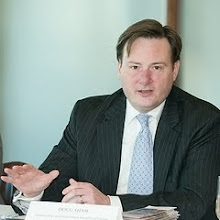
Undersecretary of State for International Security and Arms Control Ellen O. Tauscher shared her perspectives on her current tasks and her career with students and faculty of the Elliott School of International Affairs on November 10 as part of the Elliott School's Distinguished Women in International Affairs event series.

Observing that organizational units in the State Department have "code" letters -- "we even have an M, although he's not a secret agent" -- and that her bureau is known as "T," Undersecretary Tauscher related that Secretary of State Hillary Clinton has asked her to "resurrect the T family."

“T” could do with some resurrection. Under the leadership of John Bolton, famously hostile not only to arms control but also to the United Nations to which he later represented the United States, the bureau was "reorganized." These reorganizations appear to this outside observer to have significantly degraded the U.S. Government's capacity to lead and sustain international cooperation to prevent the spread or use of nuclear weapons.

Secretary Clinton's direction to Undersecretary Tauscher is thus much needed and reflective of the deep engagement and effective leadership both have shown over time on the challenge of nuclear weapons proliferation.

"Resurrection" is an important and complicated word in this context. Then Undersecretary Bolton's "reorganization" was structural -- it continues to constrain the function of the Bureau after his departure. So Undersecretary Tauscher's resurrection should be structural as well, creating new enduring capacity. A very welcome project to those who believe international law can be used to protect national and global security.

There is, however, an asterisk to this formulation in the mind of longtime observers of the organization of the U.S. Government for proliferation prevention. As the head of the "T family,” Undersecretary Tauscher is one of six undersecretaries. In contrast to the Undersecretary for Political Affairs, she has no foreign government “clients” – she represents only the U.S. Government’s commitment to promote international security through diplomacy.

Sometimes the requirements of effective global nonproliferation align with the requirements of strong bilateral relations with U.S. friends and allies. Sometimes this alignment is more difficult to achieve. In this latter class of cases, it is crucial that the requirements of preventing the spread of nuclear weapons have a strong champion, like Undersecretary Tauscher, to ensure that they are not drowned out by a host of bilateral diplomatic concerns, sometimes with significant economic implications.

This is a major challenge, worthy of the talents of a proven leader like Undersecretary Tauscher. But it used to be a little easier.

From 1961 until 1997, the U.S. Arms Control and Disarmament Agency (ACDA) was legislatively established as independent of the State Department. This meant that whenever conflicts arose among the various Undersecretaries of State, the requirements of prevention of proliferation or use of weapons of mass destruction could be raised by the ACDA director one-on-one with the Secretary and, if necessary, the President. The ACDA director had his (sadly, the ACDA directorship no longer exist for Ellen Tauscher to break the male monopoly) own seat on the National Security Council reflecting the extraordinary danger weapons of mass destruction pose to U.S. national security. In observing that these dangers persist, we should think carefully about the future structure of the U.S. Government to effectively face them.

Thursday, October 29, 2009

Global Zero World Summit -- student opportunities

The following is posted at the request of Claire Morelon from Global Zero. If you are a GW student, of course, I'm also interested in knowing if you're planning to apply.

Seeking Student Representatives at the Global Zero World Summit in Paris, February 2010Global Zero, a new international campaign to eliminate nuclear weapons, is looking for a handful of smart savvy, entrepreneurial university students to attend the Global Zero World Summit in Paris this coming February as representatives of a growing youth-led movement for the elimination of nuclear weapons worldwide.Applications are to be submitted online and are due by 11:59PM on Monday, 30 November 2009.

English-language application:
http://www.globalzero.org/en/world-summit-students

French-language application:
http://www.globalzero.org/fr/sommet-mondial-etudiants

Applications will not be considered complete until applicants submit a CV/resume and a short writing sample via email with the following subject line: "Paris Application - Writing Sample" to Claire Morelon (cmorelon@globalzero.org).

Global Zero is spearheaded by a group of over 200 world leaders – including President Jimmy Carter, Queen Noor, Sir Malcom Rifkind, Mikhail Gorbachev, Archbishop Desmond Tutu, among others, The campaign’s work includes a world summit in 2010, a comprehensive plan for zero authored by Global Zero Commissioners, a global online and grassroots campaign, and a major documentary from Academy-Award winning producers.Global Zero is looking for a handful of smart savvy, entrepreneurial university students to attend the Global Zero World Summit in Paris this coming February as representatives of a growing youth-led movement for the elimination of nuclear weapons worldwide. A small group of applicants who have demonstrated commitment to the mission of Global Zero as well as potential to be strategic movement organizers will be selected to attend the Global Zero World Summit in Paris in February 2010. At the Summit, these Global Zero Student Leaders will work alongside other students from around the world and Global Zero signatories to chart a course toward a world without nuclear weapons. Travel, room & board, and training will all be provided. Exact dates and a complete agenda are TBD - please check the website for updates.The application form can be found by clicking or pointing your web browser to the link below:http://www.globalzero.org/en/world-summit-students

There is also a french language application available here:http://www.globalzero.org/fr/sommet-mondial-etudiants

There is a growing consensus among world leaders that the only way to prevent the spread of nuclear weapons and end the threat of nuclear terrorism is to eliminate all nuclear weapons. Recent efforts by Presidents Obama and Medvedev, as well as a summit-level United Nations Security Council resolution endorsing the goal of a world free of nuclear weapons, give us an unprecedented window of opportunity to act.We are looking forward to meeting the next generation of leaders for zero! Interested individuals should complete and submit the application by Monday, 30 November

Wednesday, July 8, 2009

Global Zero Seeks Young Leaders

Parsa Bastani at Global Zero forwards the following opportunity for undergrads:

On July 22, we're launching the Global Zero Student Summer - a 3-week program for students in Washington, DC to meet Global Zero commissioners and participate in organizing and media trainings with top practitioners in their fields.

We're looking for some smart, savvy, and entrepreneurial young people - current college students, incoming freshmen, or students on a gap year - who will embrace the once in a lifetime opportunity to sit down with Global Zero Commissioners Dr. Tony Lake, Ambassador Thomas Pickering, and Ambassador Richard Burt to hear why they believe we can achieve global zero. In the fall, participants in the Global Zero Student Summer will deploy back to their campuses to start local Global Zero chapters, leading our growing grassroots movement for global zero.
Apply Now http://www.globalzero.org/en/student-summer> for the Global Zero Student Summer (July 22-August 7, 2009 in Washington, DC)

Monday, June 29, 2009

Global Zero roles forward


The Global Zero Commission announced an “Action Plan,” a “step-by-step process to achieve total elimination of nuclear weapons,” today in press conference at the St. Regis Hotel in Washington, D.C. ahead of the scheduled Moscow Summit between President Barack Obama and Dmitry Medvedev.

The Commission is comprised of experts from seven states that maintain nuclear arsenals, as well as Japan and Germany.

Global Zero Commission member and former U.S. Strategic Arms Reduction Treaty negotiator Ambassador Richard Burt explained that the Global Zero Commission does not have all the answers or the only possible solution and looks to be collaborative with others engaged in the work of nuclear disarmament, but that today’s plan adds something different to this discussion because it is focused on the long-term development of a multilateral process for getting to zero nuclear weapons. Ambassador Burt and other Commission members emphasized that their effort was realistic, practical and pragmatic and that the:
“risks of nuclear weapons outweigh any stabilizing effect of nuclear weapons…We’re at a point where nuclear weapons will no longer be a weapon of the strong, they will increasingly be a weapon of the weak.”
Ambassador Burt carefully observed that testimony provided to the Commission suggests that governments and intelligence agencies have in every case been able to provide clear indication when and in what countries nuclear weapons development was underway. Former Ambassador of the United States to the United Nations, Russia, and India Thomas Pickering explained that the Global Zero Commission’s plan extends over fourteen years for the negotiation of the various constituent agreements and another seven years to complete dismantlement of existing nuclear arsenals.

Former Pakistani Foreign Secretary Ambassador Shahryar Khan affirmed that “Pakistan has absolutely no reservations” about going forward on the Global Zero path, and that with Pakistan’s leadership, most other Islamic countries would follow suit.

Former Permanent Representative of the People’s Republic of China to the United Nations, Ambassador Jianmin Wu, observed that:
“the threat is felt not only by developed countries, but also by developing countries."
The Commission will convene again in the fall (probably in Moscow) to more thoroughly flesh out the plan, while continuing to consult with governments and reach out the public. A “Global Zero Summit” is planned for January of next year in Paris.

We applaud this effort and agree that the prompt creation of an inclusive global dialogue about the future of nuclear weapons that engages governments not yet involved in the nuclear arms reduction process as well as international civil society and the global public is extremely important.

Thursday, March 26, 2009

The Role of Higher Education in Transforming Nuclear Weapons Policy

“The one thing we know about policy windows is that, as sure as they open, they close. If you think change is permanent, you don’t understand change…If we miss this moment, we fail.” -- Joseph Cirincione, President, The Ploughshares Fund
Ploughshares Fund President Joseph Cirincione gave a rousing and incisive presentation to an audience of fifty at the George Washington University’s Elliott School of International Affairs last night on the topic of “Barack Obama’s New Nuclear Policy.”

Highlighting the importance of what the New York Times editorial page had earlier in the day called a “Watershed Moment on Nuclear Arms,” Mr. Cirincione described the extraordinary political momentum in the United States and internationally, the activity of new and important validators (including George Shultz, Sam Nunn, Henry Kissinger, and Bill Perry) of moving toward the abolition of nuclear weapons, the agenda and team that the Obama Administration has put in place to lead a transformation of U.S. nuclear weapons policy, and the challenges this transformation will face in the window of a year or two in which the conditions remain right to make it happen. On nuclear weapons policy, he observed, “this Administration is going to be characterized as a struggle between the transformationalists and the incrementalists.”

Mr. Cirincione offered specific thoughts about the role that universities can and should play in the debate over the future of nuclear weapons policy, nonproliferation, and disarmament. First, he observed the extraordinary contribution of Stanford University, where faculty members George Shultz and Bill Perry have convened an ongoing discussion among scholars and practitioners about “Steps Toward a World Free of Nuclear Weapons” under the heading of “Reykjavik Revisited,” recalling the summit meeting between then U.S. President Ronald Reagan and Soviet Premier Mikhail Gorbachev in October 1986. Mr. Cirincione pointed out that “this whole movement was hatched at a university.”

Universities “change the paradigm; you change the way people are thinking about this,” argued Mr. Cirincione, who also encouraged universities to support scholars with breakthrough ideas and to do serious research in the area of nuclear nonproliferation and disarmament. He emphasized that universities should provide fora for public debate on nuclear weapons policy, including opposing viewpoints, and also provide venues for U.S. Government officials to connect with the public.

Finally, Mr. Cirincione included students specifically in his call to “get involved” and make political leaders care about nuclear weapons policy. He encouraged students to use the newer media – including blogs, Facebook, and twitter – to tell others what they’re thinking and “demand that your professors organize more meetings….join Global Zero…there are a hundred things that you can do about this.”

In closing, Mr. Cirincione reflected on the late President John F. Kennedy’s observation upon banning explosive testing of nuclear weapons in the atmosphere: “if I’d known it was so popular, I would have done it a long time ago.”

Monday, December 8, 2008

France out front in a brace of moves toward nuclear disarmament

The Associated Press reports that a letter from French President Nicholas Sarkozy to United Nations Secretary General Ban Ki Mun outlines a European Union plan to advance global progress toward nuclear disarmament:

"Europe has already done a lot for disarmament…[and]…Europe is ready to do more."
French newspaper Le Figaro reports that the December 5 letter supports further (post-START) nuclear arms control negotiations between the United States and Russia, universal ratification of the Comprehensive Test Ban Treaty and dismantlement of all nuclear installations as soon as possible in a transparent and open way (the article notes that this issue refers particularly to Russia and China which maintain operational testing sites), a moratorium on fissile material production, and short- and medium-range surface-to-surface ballistic missiles.

With regard to a fissile material production cutoff, The Times of India reports:
"The opening without delay and without preconditions of negotiations on a treaty forbidding the production of fissile material for nuclear weapons, as well as the implementation of an immediate moratorium on the production of these materials."
Le Figaro notes the intent of the letter is to “raise the debate to the level of heads of state.”

The letter carries added multilateral weight as France currently holds the rotating presidency of the European Union, a post it will relinquish this month.

President Sarkozy’s letter foreshadows tomorrow’s official launch in Paris of the “Global Zero” citizens campaign for a world without nuclear weapons. Featured leaders of this effort include former United Kingdom Foreign Secretary Margaret Becket who proposed last year that her country become a “disarmament laboratory” to develop the verification procedures and technology necessary to move toward the abolition of nuclear weapons. Entrepreneur and adventurer extraordinaire Sir Richard Branson is another campaign leader – having built the Virgin brand into a global phenomenon, he is perhaps uniquely qualified to again popularize the “unnatural act” of arms control.